

General articles, Thomas Turner blog
The Dreadnought Sea Angling Society Established 1911
Mar
The Dreadnought Sea Angling Society Established 1911
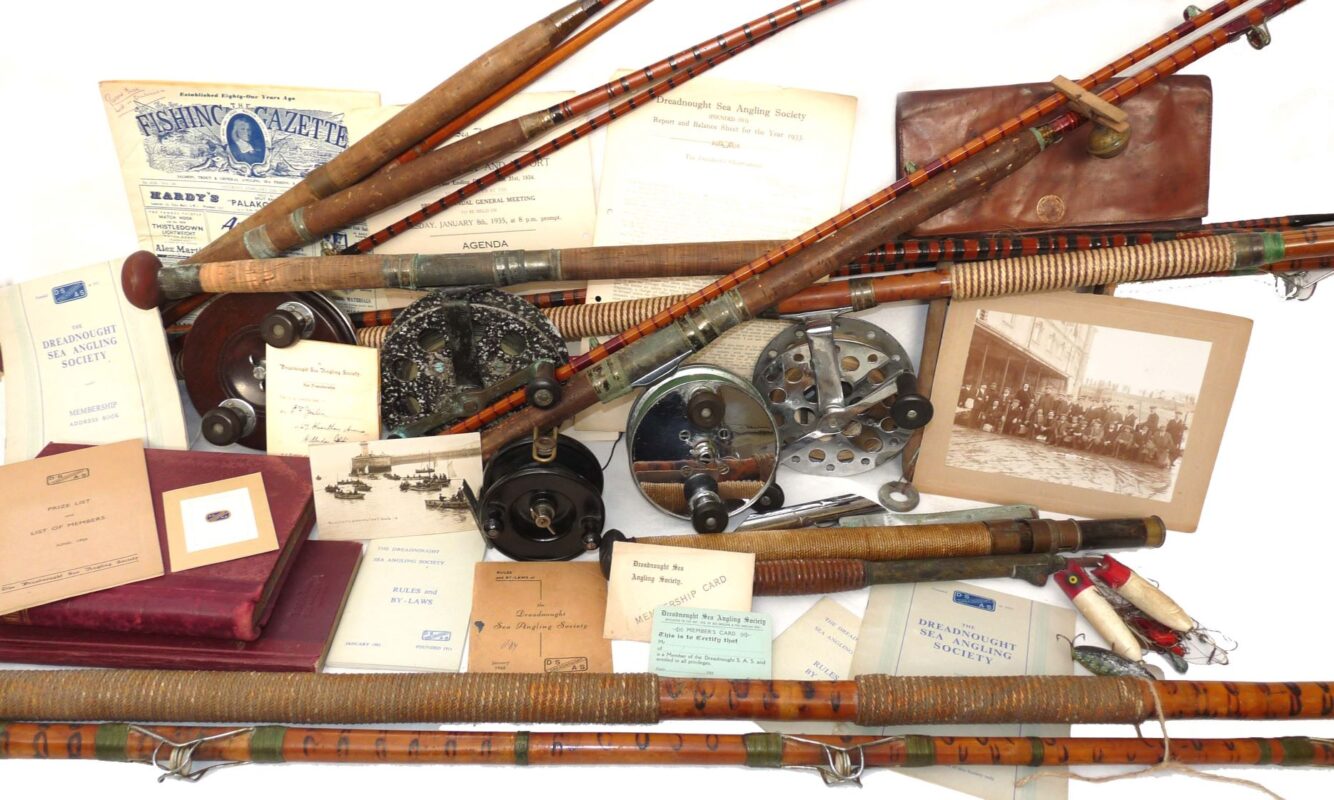
One of the great features of this job are the people you meet and the tackle you see. A call from greater London sent us hot footing to the family home of a departed sea angler. He passed away at the young age of 104 years old and led a full life according to his family. Flying single engine aircraft and racing motorcars well into his 90’s I would have loved to have sat and chatted with him, he sounds a character with a capital C. A member of London’s Dreadnought Sea Angling Society. Fishing from Boat, beach pier or rock, he fished everywhere on the south coast over to Ireland on a frequent basis.
This tackle is very unusual. The four reels (plus a few Bakelite models) are all very different, no makers marks and all just a bit odd. Two 6” ventilated narrow drum trolling models have double handles like those occasionally seen on Hardy big game reels. The others are stainless and wooden reels of 4 and 5” diameter. All well fished, all working, and with the jumbled collection of cane rods, metal jigs, gaff and heavy line it makes a great display. The reels deserve further research perhaps to find a maker to complete the history.

The Dreadnought Sea Angling Society was established in 1911 having taken over from the British Sea Anglers Society est. 1893. Meeting weekly at a prestigious Fleet St Club in London they encouraged the upper echelon of the landed gentry to enlist. The inaugural meeting on 24th February was attended by 5 members including the secretary Herr Otto-Schultz who took the minutes in German. The enthusiasm for fishing and all its associated events motivated the newly named Dreadnoughts to move forward as a club, establishing themselves as the premier sea fishing club. They branched out to unchartered waters, off the Irish coast, to catch new and exotic species.
As 1914 approached Schultz made his permanent return to Germany and a new President was elected. Miss Levy, the secretary, was meticulous not only in her detailed note taking in English but her beautiful flowing script hand wring in black ink was admired by all.
Any new members were encouraged to bring along their boats and a strong competition ethos developed.
Such was the organisation, that at the 12th January meeting, the list of the clubs’ chattels included; nine flags, one landing net, one fish board, one measuring device, one hammer, one cashbox and two badges. The first prize outing competition was held at Brighton and the rest is history.
The Dreadnoughts were determined to keep a strong moral code and family ethos throughout. Wives and children were encouraged to join in both the fishing trips and the frequent dry land parties and gatherings. Many members enjoyed all forms of fishing and the society was keen to show and record any notable fish and catches. Mr Cecil Teague-Ghillie’s 13lb salmon and a 3-1/2lb twaite shad caught in 1960 made a notable feature in the club publication.
The 1968 Hicklenton & Philipps Ltd, antique silver and diamond merchants of London, appraised the clubs trophy collection for insurance and presented a schedule totalling £2,190, equivalent to £18,000 in today’s money. In with the masses of original papers, club meeting notes, handbooks, and articles I found two facsimile letters. One dates 5th October 1939 to the Right Honorable The Prime Minister (Neville Chamberlin) complimenting him on his work and inviting him to join the Dreadnoughts for a spot of fishing. A reply was sent 24th October from Chamberlain at 10 Downing Street, Whitehall expressing his warm thanks for the kind message.

This collection will be sold as one and it deserves a prominent place on display. When the paperwork has been further sifted and categorised not only will this be a fine vintage fishing collection but a timewharp social history paper trail looking back into our angling past through two World Wars and on.
